Tuesday, January 4, 2022

Maryland State - Emergency Proclamation and Executive Orders


Joint Association COVID-19 Update (#328)


Emergency Proclamation, Executive Orders, and

Updated MDH Vaccine Bulletin


Today, Governor Larry Hogan and the Maryland Department of Health (MDH) released a new emergency proclamation, order on healthcare matters, an EMS workforce order, and an updated MDH provider bulletin. Please click the links below to review the documents and share with your teams as appropriate.


·         Proclamation

·         Declares a state of emergency and catastrophic health emergency.


·         Healthcare Matters

·         Authorizes certain actions by the Secretary of Health.

·         Allows for expanded scope of healthcare practitioners' licenses.

·         Allows nursing graduates to function as full RNs, with supervision.

·         Allows interstate reciprocity for healthcare licenses & inactive health care practitioners to practice.

·         Activates the Maryland Responds Medical Reserve Corps.


·         EMS Workforce Order

·         Authorizes certain actions by MIEMSS to augment healthcare workforce.


·         Updated MDH Provider Bulletin

·         Per FDA, expands booster/additional dose eligibility and other technical amendments.


Want to see previous HFAM updates?


Visit our website to view all previous HFAM alerts, as well as guidance

from our federal and state partners.


Health Facilities Association of Maryland WW.HFAM.ORG

Facebook‌ Twitter‌ LinkedIn‌


Saturday, January 1, 2022

Life-Long Learning in Montgomery County and beyond

During this time of slow recovery from the Covid-19 pandemic and continued social distancing, the County wants to ensure everyone stays connected to helpful supports and maintain daily enjoyment. We are very pleased that Montgomery County providers and non-profit organizations throughout the US have done such an excellent job presenting their programming online and via telephone.

Through the County's Caregiver Blog we provide updates on virtual happenings that will enhance the lives of caregivers and their loved ones. We feature: Engage@HOME and Podcast episodes, plus list programs that are low cost or freely available, whether you seek lifelong learning, health and wellness, support groups, fitness, access to our libraries and much more.
Click here to visit the County's Caregiver Blog

In response to Covid-19, Life Long Learning Center's have adapted their programs and are now offering virtual classes. Please visit each of the center's website to learn more.


MONTGOMERY COUNTY HAS FIVE LIFELONG LEARNING CENTERS


Through academic research it has been proven there are significant benefits associated with learning and social engagement. During this time when many continue to stay indoors we are thrilled to see our local lifelong learning organizations adapt their programs to virtual sessions. Also, you may be caring for a loved one who will appreciate a "no stress" opportunity to keep engaged. No need to dress up either!

Everyone now can enjoy non-academic classes through lifelong learning non-profit centers in the region. Generally, classes are offered as single sessions at affordable prices. Their programs include classes in computer training, fitness, topical events, languages, history, music, health, guidance on successful aging, and caregiver support.

Click the links below will take you on a journey exploring local lifelong learning: Montgomery College, Oasis, Live and Learn Bethesda, Senior Planet, and OLLI.
Additionally, County Residents can access national programs that provide both caregiver programming and general lifelong learning for older adults. These include Covia - Well Connected, Caregiving TeleConnection, The Smithsonian, NPR and so many for outstanding organizations.  See just a few listed below.


Click here

Click here
click here
Click here


click here 


WellMedFoundation's Caregiver Teleconnection
The Caregiver Teleconnection program has one-hour conference calls, at no cost. These sessions cover a wide range of interesting topics related to the care you provide to your loved one. You can get expert advice, ask questions and talk to other people who are also providing care. Offering you the support and education you need to help you take care of yourself and your loved one. Click here to view their lives and recorded programs.


Go4Life

ENDURANCE. STRENGTH. BALANCE. FLEXIBILITY.
Go4Life, an exercise and physical activity campaign from the National Institute on Aging at NIH, is designed to help you fit exercise and physical activity into your daily life.
Click here to stay new fitness lifestyle


Leading Age Podcast 
Aging Unmasked PodcastAging Unmasked is a new podcast from LeadingAge where we normalize, humanize, and unmask taboos in aging. Subscribe to Aging
Click here to listen


Well Connected - phone lifelong learning - English
CONNECT FROM ANYWHERE
The Covia Well Connected program is a community made up of participants, staff, facilitators, presenters, and other volunteers who care about each other and who value being connected. All groups are accessible by phone from wherever you are at no cost to you.
Click to start exploring


Well Connected - phone lifelong learning - Español
Este galardonado programa ofrece actividades, educación, grupos de apoyo y conversaciones amistosas por teléfono o en línea.
Conéctese desde cualquier lugar
Well Connected Español es una comunidad compuesta de participantes, empleados, facilitadores, presentadores, y otros voluntarios que se preocupan por los demás y que valoran estar conectados. Todos los grupos son accesibles por teléfono o computadora desde cualquier lugar sin costo alguno.


EdX - Online University Education classes
edX is the trusted platform for education and learning. Founded by Harvard and MIT, edX is home to more than 20 million learners, the majority of top-ranked universities in the world and industry-leading companies. As a global nonprofit, edX is transforming traditional education, removing the barriers of cost, location and access. Fulfilling the demand for people to learn on their own terms, edX is reimagining the possibilities of education, providing the highest-quality, stackable learning experiences including the groundbreaking MicroMasters® programs. Supporting learners at every stage, whether entering the job market, changing fields, seeking a promotion or exploring new interests, edX delivers courses for curious minds on topics ranging from data and computer science to leadership and communications. edX is where you go to learn.
Click here to visit the EdX special Covid-19 webpage


TED Talks - Respected lectures

TED is a global community, welcoming people from every discipline and culture who seek a deeper understanding of the world. We believe passionately in the power of ideas to change attitudes, lives and, ultimately, the world. On TED.com, we're building a clearinghouse of free knowledge from the world's most inspired thinkers — and a community of curious souls to engage with ideas and each other.


MIT Open Courseware

Unlocking Knowledge - MIT OpenCourseWare (OCW) is a web-based publication of virtually all MIT course content. OCW is open and available to the world and is a permanent MIT activity.
Empowering Minds - Through OCW, educators improve courses and curricula, making their schools more effective; students find additional resources to help them succeed; and independent learners enrich their lives and use the content to tackle some of our world’s most difficult challenges, including sustainable development, climate change, and cancer eradication.Click here to explore MIT OCW


NPR at your fingertips
It is easy to keep in touch with current events, topical issues, cultural conversations
At the top of the NPR webpage you select from the follow broad catagories:
- News
- Arts and Life
- Music
- Shows and Podcasts
- and the opportunity to Search
Under each category you can then take a deep dive into the extensive array of NPR broadcast, past shows and programming.
Click here to stay your NPR enjoyment


The Smithsonian
Smithsonian is a community of learning and the opener of doors. We invite learners of all ages and educators everywhere to discover our extraordinary collections and research. The Smithsonian virtual platforms allow visitors to take self-guided, room-by-room tours of several exhibits and areas within the museum from their desktop or mobile device. ... You can explore the virtual tours here.


Reducing Loneliness: How to Help Seniors During the Holidays


Author: Carol Bradley Bursack, Minding Our Elders | Updated November 9, 2021
Originally published on the AgingCare website

There is a lot of pressure on people to enjoy themselves during the holidays. The season is supposed to be merry and bright, but many elders feel increasingly isolated and unhappy this time of year—even before the coronavirus pandemic complicated everyday life and special occasions. Understandably, families are still concerned about how minimizing COVID-19 risk will affect their holiday plans with aging loved ones this year.

Why Seniors Experience Holiday Loneliness

While aging can bring wisdom and experience, there are inevitable losses that even the healthiest seniors face. Loved ones and friends fall ill and pass away. Energy and mobility levels often decrease, resulting in feelings of lost independence and opportunities. Neighborhoods change over time, leaving even those well enough to remain in their own homes feeling lonely and disconnected from their communities.

According to the National Institute of Mental Health (NIMH), socially isolated older adults are at higher risk for depression. The focus on family, friends and togetherness during this time of year can actually bring melancholy feelings to the forefront for many elders. It’s more important than ever to be supportive of and attentive to our loved ones, but in ways that keep everyone as safe and healthy as possible.

If you believe that an aging parent, friend or neighbor may be feeling lonely or depressed, there are steps you can take to help lift their spirits. You are probably busy with adapting your own holiday plans and traditions, but we must remind ourselves what the holiday season is truly about. Simplifying some things will allow you to focus on what really matters: the important people in your life. Use these ideas to brighten up a loved one’s winter season.

10 Tips for Reducing Loneliness During the Holidays
Make a point of actively listening when your loved one wants to talk, even if the discussion is negative. An honest and empathetic conversation can help them process what is bothering them, whether they are mourning a loss or coming to terms with new challenges in life. It may also reveal why they are feeling down and inspire other ways of lifting their spirits.
Remind them how important they are as a part of your life, your family members’ lives and these annual holiday celebrations. They may feel useless or burdensome if they cannot contribute to or fully participate in the festivities like they used to. Encourage them to do what they are capable of and be especially careful not to act like what you do for them is done out of a sense of duty. Show them they are loved.

Over the years, holiday cards often bring bad news and diminish in quantity. I used to sit with my mom when she opened her cards because so many of them brought news of illness or death. She was also keenly aware of the people she didn’t hear from. Be gentle with your loved ones if these annual greetings are an important tradition of theirs. If possible, ask family members and friends to contribute cards, photographs or drawings to help keep the senior’s seasonal mail more upbeat. My mom needed this connection with her life-long friends, so I helped her write her own outgoing cards each year as well.

Help your loved one see that you are trying to simplify your holiday plans to focus on the real meaning of these celebrations. Let them know you are trying to ignore the increasing hype over food, gifts, decorations and parties in order to focus on the people and values you cherish. Remind them that they have taught you the importance of family and friendship and thank them for that.
If a senior is in a long-term care facility, check with the activities director and local schools or extracurricular programs to see if they can arrange for children to do virtual or distanced visits with or performances for the residents. New activities and interactions with younger generations can be very uplifting for elders who are in physical or emotional pain. Visiting pet therapy is another source of entertainment and socialization that can bring joy to seniors whose social lives have been significantly impacted by COVID-19.

Check with your loved one’s religious organization to see if they can offer extra social and/or spiritual support. For example, the Stephen Ministry is a program offered by many Christian churches that provides one-on-one support to those who are having difficulties in life. Many houses of worship can arrange for a congregant or leader to visit a senior in need, either in person or virtually. Just having someone to talk to can go a long way toward relieving depression.
Help them add festive touches to their home or room in the long-term care facility. Ensure that these items do not present a safety hazard and try to decorate in stages to prolong the fun and give them something to look forward to. Many seniors enjoy reflecting on past holidays as they unpack cherished decorations, so be sure to listen to their stories and ask about special pieces. If you can’t be there in person, at least phone or video call while they’re decking the halls. Some small, easy-to-use decorations in senior apartments include removable window clings, garland, and artificial wreaths or floral arrangements.

Cook traditional baked goods or treats with your loved one if it is safe to get together in person. If they reside in an assisted living facility or nursing home, bring familiar treats that represent your holiday customs for your elder to enjoy and share with their friends. Try to make their dining table festive, too, by offering to send themed decor, appropriate colors and seasonal flavors.
One year, I was able to use a small conference room at my parents’ nursing home to host a New Year’s Eve party for them and their friends. They absolutely loved it. Just be sure to follow current CDC guidelines for minimizing COVID-19 risk at holiday gatherings. If traditional holiday parties or gatherings can’t be held in a safe way, call your elder’s friends and/or family to see if they would be able to attend a virtual gathering instead. Keep in mind that it doesn’t necessarily have to be on a particular holiday. Realizing that the people they care about dialed in to spend time with them is priceless for an elder. Consider keeping virtual get-togethers small for elders with dementia so they do not get confused or overwhelmed. Technology can be disorienting and too many participants may cause them to become frustrated.

The most important thing you can do with a senior to make them feel loved and included this season is to simply spend time with them in a safe way. Look at family photos, watch home videos or holiday movies, listen to seasonal music, or do crafts together. For some, these traditions may need to take place outside (weather permitting), via FaceTime or Zoom, or while you social distance and wear masks. Regardless of what you decide to do together, any time you can spare is a precious gift.
Coping With COVID-19 Concerns, Seniors and the Holidays

Knowing how to juggle seniors and the holidays can be tough, especially as the coronavirus pandemic continues to be a concern. Although CDC researchers and mathematical forecasting models project that cases and deaths are likely to decline over the coming months, most of the country is still experiencing high levels of community transmission. Vaccination remains the best method of reducing one’s risk of contracting COVID-19 and preventing hospitalization and death. In addition to these health benefits, most fully vaccinated individuals are able to resume activities they did prior to the pandemic, such as traveling and gathering with family and friends. Keep in mind that additional precautions like masking and social distancing may still be required or recommended for certain individuals and in some settings.

Do what you can to help your aging loved one feel involved and get into the holiday spirit without stressing yourself beyond your limits or risking anyone’s health. If you put too much on your plate, it is likely that neither you nor your loved ones will enjoy the festivities nearly as much. Remember that most families are still facing difficult holiday and travel decisions this year. Get creative, stay safe and remember that your best efforts are good enough.

For more information and recommendations regarding personal and social activities during the coronavirus pandemic, visit CDC.gov.


Long Distance Caregiving - How to Share Caregiving Responsibilities with Family Members

Caring for an older family member often requires teamwork. While one sibling might be local and take on most of the everyday caregiving responsibilities, a long-distance caregiver can also have an important role.

As a long-distance caregiver, you can provide important 
respite to the primary caregiver and support to the aging family member.
Click here to read the full article


Talk About Caregiving Responsibilities


First, try to define the caregiving responsibilities. You could start by setting up a family meeting and, if it makes sense, include the care recipient in the discussion. This is best done when there is not an emergency. A calm conversation about what kind of care is wanted and needed now, and what might be needed in the future, can help avoid a lot of confusion.

Decide who will be responsible for which tasks. Many families find the best first step is to name a primary caregiver, even if one is not needed immediately. That way the primary caregiver can step in if there is a crisis.

Agree in advance how each of your efforts can complement one another so that you can be an effective team. Ideally, each of you will be able to take on tasks best suited to your skills or interests.
Consider Your Strengths When Sharing Caregiving Responsibilities

When thinking about who should be responsible for what, start with your strengths. Consider what you are particularly good at and how those skills might help in the current situation:
  • Are you good at finding information, keeping people up-to-date on changing conditions, and offering cheer, whether on the phone or with a computer?
  • Are you good at supervising and leading others?
  • Are you comfortable speaking with medical staff and interpreting what they say to others?
  • Is your strongest suit doing the numbers—paying bills, keeping track of bank statements, and reviewing insurance policies and reimbursement reports?
  • Are you the one in the family who can fix anything, while no one else knows the difference between pliers and a wrench?

Consider Your Limits When Sharing Caregiving Responsibilities

When thinking about who should be responsible for what, consider your limits. Ask yourself the following:
  • How often, both mentally and financially, can you afford to travel?
  • Are you emotionally prepared to take on what may feel like a reversal of roles between you and your parent—taking care of your parent instead of your parent taking care of you? Can you continue to respect your parent’s independence?
  • Can you be both calm and assertive when communicating from a distance?
  • How will your decision to take on caregiving responsibilities affect your work and home life?

Be realistic about how much you can do and what you are willing to do. Think about your schedule and how it might be adapted to give respite to a primary caregiver. For example, you might try to coordinate holiday and vacation times. Remember that over time, responsibilities may need to be revised to reflect changes in the situation, your care recipient’s needs, and each family member’s abilities and limitations.
How to Support a Local Caregiver from Far Away

Read and share this infographic and help spread the word about these six tips for long-distance caregiving.

A spouse or the sibling who lives closest to an aging parent often becomes the primary caregiver. Long-distance caregivers can help by providing emotional support and occasional respite to the primary caregiver. Ask the primary caregiver what you can do to help. Staying in contact with your parents by phone or email might also take some pressure off your parent or sibling. Just listening may not sound like much help, but often it is.

Long-distance caregivers can also play a part in arranging for professional caregivers, hiring home health and nursing aides, or locating care in an assisted living facility or nursing home (also known as a skilled nursing facility).

Long-distance caregivers may find they can be helpful by handling things online—for example, researching health problems or medicines, paying bills, or keeping family and friends updated. Some long-distance caregivers help a parent pay for care; others step in to manage finances.
How to Help a Parent Who Is the Primary Caregiver

A primary caregiver—especially a spouse—may be hesitant to ask for help or a break. Be sure to acknowledge how important the caregiver has been for the care recipient. Also, discuss the physical and emotional effects caregiving can have on people. Although caregiving can be satisfying, it also can be very hard work.

Offer to arrange for respite care. Respite care will give your parent a break from caregiving responsibilities. It can be arranged for just an afternoon or for several days. Care can be provided in the family home, through an adult day services program, or at a skilled nursing facility.

Click here to read the full article


National Institutes on Aging - advice for caregivers

The NIH - National Institute on Aging has more valuable information to share with caregivers.

Click here to view the full list of resources.


Legal and Financial Planning for People with Dementia
Find out when and how to start making legal and financial plans for someone with Alzheimer's or a related dementia. Advance directive, will, and other terms are defined.


Going to the Hospital: Tips for Dementia Caregivers
Going to the hospital can be stressful for someone with Alzheimer's disease or another dementia. Know what to expect and how to prepare for an ER or hospital visit.


Getting Help with Alzheimer's Caregiving
Looking for respite care or help with Alzheimer's caregiving? Learn about supportive resources like home care, adult day care, meal services, and hospice.


Holiday Hints for Alzheimer's Caregivers
Learn how to balance busy holiday activities with everyday care for a person with Alzheimer's disease.


What Is a Geriatric Care Manager?
A geriatric care manager can help you and your family identify caregiving needs and ways to meet them. Learn about the services they provide, and questions to ask during an interview.


What Is Respite Care?
Respite care can provide relief for family caregivers. Learn about how respite care could help your family, and find resources to connect with services.


Doctor's Appointments: Tips for Caregivers
Caregivers can make doctor's appointments easier with these tips on talking with doctors.


When It's Time to Leave Home
Has living at home become more challenging for your older family member? Learn about what to consider when helping them decide whether it's time to move.


Assessing Changes in Memory and Function
When visiting an aging relative, you might notice they have more memory problems than last time. Find info to help you assess changes in memory and cognition.


What Are the Signs That an Aging Parent Needs Help?
How do you know if an older relative needs more help at home? Get tips to help you make sure loved ones are safe and sound when you live far away.


Activities To Do With a Family Member or Friend Who Has Alzheimer’s Disease
Find suggestions for activities that family members and friends can do with their loved one's with Alzheimer's disease or a related dementia.


Alzheimer's Caregiving: Caring for Yourself
Caring for someone with Alzheimer's? Learn how to get help from family, friends, and others. Care for your own physical, mental, and spiritual health.


Mourning the Death of a Spouse
Get help for your grief after the death of a spouse. Read about bereavement counseling, support groups, and how to get on with life without your partner.


What To Do After Someone Dies
What do you need to do after someone you love dies? Learn about who signs the death certificate, organ donation, and whether you need an autopsy.


Making Decisions for Someone at the End of Life
Being a health care proxy and making end-of-life care decisions for someone you love can be challenging. Learn what to expect.


End-of-Life Care for People with Dementia
Caring for a person with dementia at the end of life has special challenges. Help them have good quality of life as they’re dying.


Where Can I Find Care for a Dying Relative?
There’s no right place to die. Caregivers should consider the best option for their situation: home, hospital, nursing home, or another place.


Including Families and Caregivers as Part of the Health Care Team
Family and informal caregivers play a significant role in the lives of their loved ones. Learn how to communicate effectively with all of those involved in your older patient's care.


Providing Care and Comfort at the End of Life
Read about how to provide physical, emotional, and spiritual comfort to relieve suffering when caring for a loved one who is dying.


Caring for a Person With Lewy Body Dementia
Family members who care for someone with Lewy body dementia can get support to maintain health and help doctors and others understand the disease.


Click here to view the full list of resources.


10 Tips for Caregivers During the Holidays

Feeling stressed? Reset your expectations and enjoy the little moments


by Amy Goyer, AARP,

For more on caregiving, visit AARP's Care Guides.


Woman holding ornament

GETTY IMAGES

En español | For some family caregivers, the holidays can be a joyful time when spirits are lighter. It feels good to care for loved ones and enjoy time together, celebrating with family traditions. But for many the holidays also bring added stress — an already busy caregiver finds there’s even more to do during the holidays. Something’s gotta give! It’s OK to give yourself a bit of a break this year. Here are some tips to help you make it through the holiday season with more joy and less stress.

Click here to continue reading the full description and helpful tips


1. Focus on what is most meaningful
2. Simplify your holiday activities
3. Start new traditions
4. Adjust meals
5. Approach gift-giving more efficiently
6. Anticipate holiday hot buttons
7. Mind your mindset
8. Keep self-care at the top of the list
9. Connect with other caregivers
10. Ask for help


Caregiving expert Amy Goyer and her family at Christmas

COURTESY OF AMY GOYER

Amy Goyer (center) at the holidays


Holiday Hints for Alzheimer's Caregivers - from the National Institutes of Health (NIH)

Holidays can be meaningful, enriching times for both the person with Alzheimer’s disease and his or her family. Maintaining or adapting family rituals and traditions helps all family members feel a sense of belonging and family identity. For a person with Alzheimer’s, this link with a familiar past is reassuring.

An older man and woman looking at each while eating breakfast during the holidays

However, celebrations, special events, or holidays, which may include other people, can cause confusion and anxiety for a person with Alzheimer’s. He or she may find some situations easier and more pleasurable than others. The tips below can help you balance busy holiday activities with everyday care for a person with Alzheimer's disease.


Finding the Right Balance

Many caregivers have mixed feelings about holidays. They may have happy memories of the past, but they also may worry about the extra demands that holidays make on their time and energy.

Click here to continue reading this article and gain helpful hints

CaregiverTeleconnection - Online and at no cost


The Caregiver Teleconnection is a free, bilingual, and confidential program that connects caregivers and family
members to information and support through the 
telephone or “tele-learning”. Sessions are one hour in length. This non profit has extensive experience offering virtual caregiver support.

Visit the Caregiver Teleconnection website

Learn how to create an internal climate in your mind and body that makes being a caregiver healthier for you.

The Caregiver Teleconnection provides learning sessions on a variety of useful topics, hosted over the phone by professional facilitators and experts. Family caregivers have the opportunity to connect and share with others in their situation during the sessions.
Some of the topics included in the tele-learning sessions are:

There are two ways to register for a tele-learning session:
You can register via their website 24 hours a day, seven days per week. Click to register now.
You can call the Caregiver Teleconnection customer service line, Monday-Friday, 9 am-5 pm (CST) at 866-390-6491 or 210-871-7SOS (7767)Participation in the Caregiver Tele-Connection helps prevent caregiver burnout, depression and anxiety, social isolation and other problems that threaten your health. The program can help you gain a greater sense of control and improve your quality of life.


Caregiver Teleconnection On Demand
We realize that sometimes it’s difficult for caregivers to participate in our live sessions based on scheduling issues. We’ve made it easier for you to get the information you need by recording many of our live sessions.
Click to access recorded sessions!


To see the August program Visit the Caregiver Teleconnection website


Maryland State Senior Call Check


SCC Banner


SCC Image


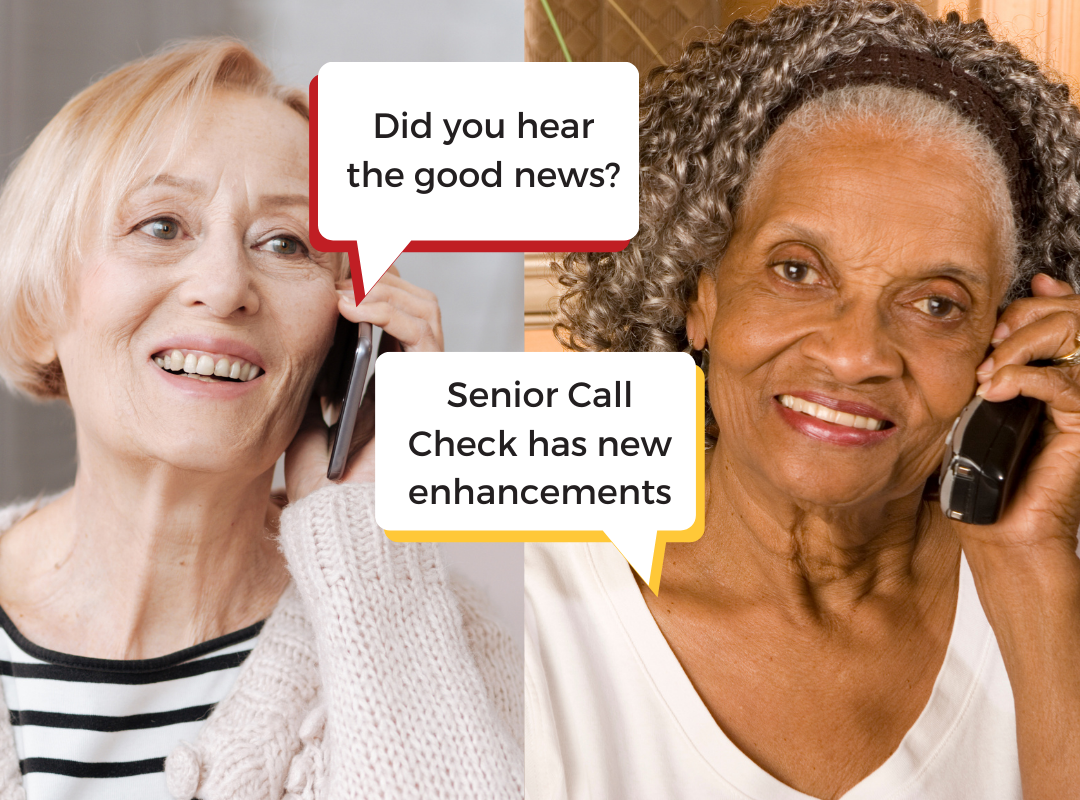
Senior Call Check Enhancements

Receive a daily automated call to verify your well-being, at a time scheduled at your convenience. Registration is free to Maryland residents 65 years of age and older.​

Senior Call Check is excited to announce two new enhancements to the program.
Online Forms:

We have added online forms to contact us. All forms are available on our website. You can submit an online form to:
Verify your Senior Call Check daily call (in case you missed it)
Pause Senior Call Check (i.e. vacation, medical procedures)
Change or update information (i.e. address change, update email, change alternate's contact information, change phone number)
Request mailed items (ex: magnets or a paper application)
Contact us (share feedback, recommendations, or concerns)
New Time Frames:

We have added two new time frame windows to receive your call. These are in addition to the current four time frame windows we offer. You can now opt in to receive your call from 11 am - 12 pm or 12 pm - 1 pm. To make this change, please call 1-866-50-CHECK (1-866-502-0560) or submit your request by clicking here.

If you are not currently a participant, sign up is free. You can register online at https://aging.maryland.gov/Pages/senior-call-check.aspx or call 1-866-50-CHECK. The Senior Call Check call center is open M-F 8 am-5 pm and Saturday 9 am-3 pm.

Well Connected - Telephone and Online LifeLong Learning (and Supports)


This is the perfect time to try out Covia Well Connected Community. They are a non-profit resource that coordinates enjoyable small group classes via the telephone and a few online. Classes are at no cost too.

MORE DETAILS:
Well Connected is a phone and online program offering activities, education, friendly conversation, and an assortment of classes and support groups to older adults accessible from the comfort of home. Our community consists of participants, staff, facilitators, presenters, and other volunteers who care about each other, and who value being connected to engaging content, and to each other. Well Connected members can play a game, learn a language, write a poem, go on a virtual tour, meditate, share gratitude, get support, and most importantly, connect and engage with others every day across the country. All groups are accessible by phone or online. Well Connected is a Community Service of Covia and is free of charge to all participants and available to adults over the age of 60.


Click here to view the  class catalog.


For more information about the Covia Well Connected Community, please click here

REPUBLISHED - National Caregiver Month - Engage@HOME YouTube Video Interviews


November is National Caregiver Month and as with previous years, the County's Engage@HOME YouTube channel has recorded a number of informative interviews with regional care providers. National Family Caregivers Month is celebrated each November and it is a time to recognize and honor family caregivers across the country.

Celebrating Family Caregivers during National Family Caregivers Month enables all of us to:
Raise awareness of family caregiver issues
Celebrate the efforts of family caregivers
Educate family caregivers about self-identification
Increase support for family caregivers

In Montgomery County our 2021 theme is RENEWAL and our guests share:
  • Words of wisdom for caregivers so they can discover new inner strength and community supports
  • Creative ideas that could include art, music, lifelong learning etc.
  • Practical examples that will help caregivers deal with “day-to-day” challenges.
  • Updates on resources and tools.
  • and much more.

to view the 
County's Engage@HOME 2021 National Caregiver Month interviews


There you will find interviews with:

Jennifer Brush
Internationally recognized expert in Montessori and Aging and member of the Ohio Council For Cognitive Healthy


Dr Patrice McGhee 


Sister Kathy Weber
Holy Cross Caregiver Resource Center

50+ in Montgomery County


Montgomery County's YouTube Channel - Engage@HOME provides throughtful curated video programming: https://www.youtube.com/c/mocoengageathome
Engage@HOME is produced and hosted by Lylie Fisher.